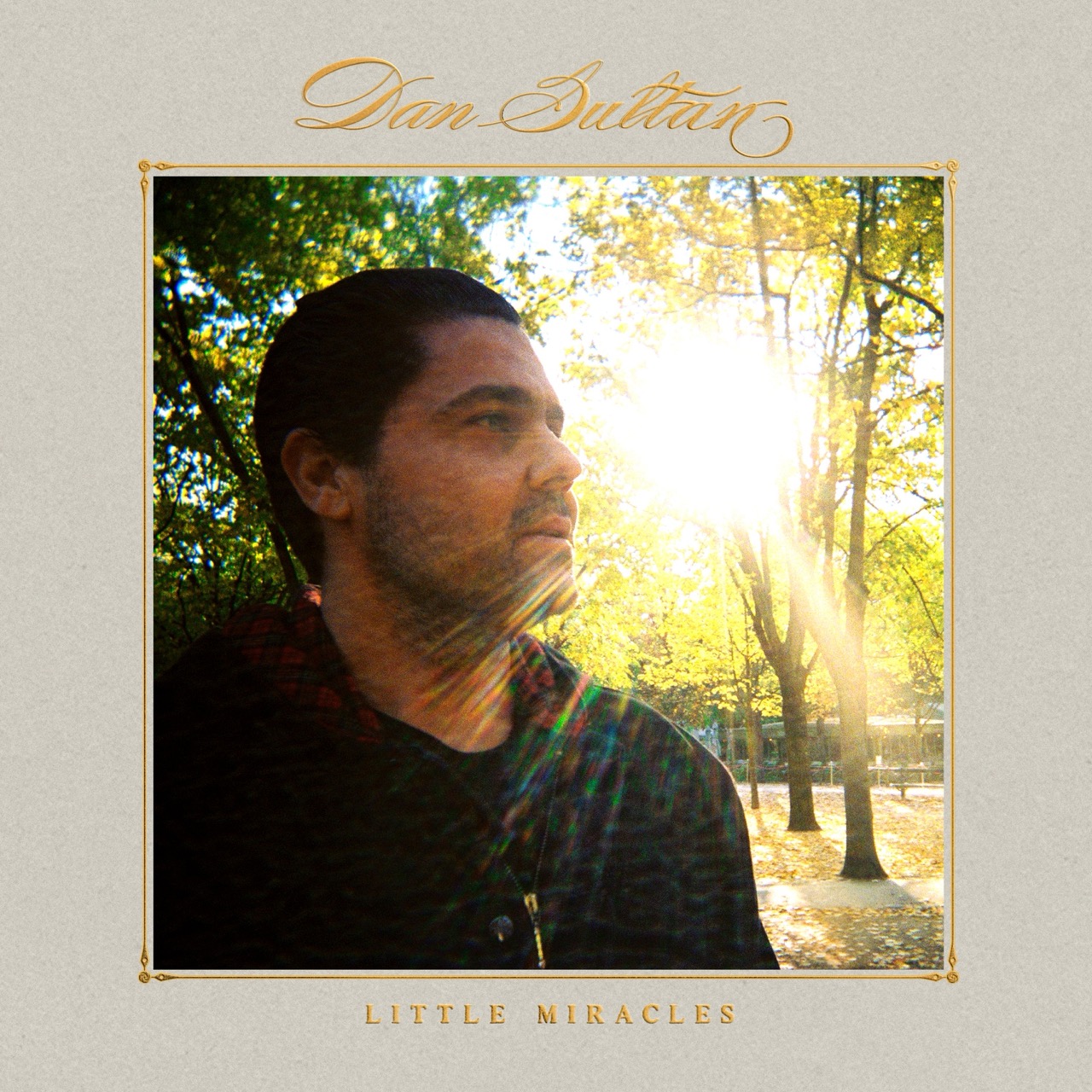
You can’t really call Dan Sultan an underdog…
Over his 20-plus-year career, he’s won multiple ARIAs, performed on stages across the world, racked up millions of streams, and built a massive following. Just last year, he played to six thousand people at the Sydney Opera House Forecourt. But there’s still this feeling that he hasn’t quite received his flowers. So maybe not an underdog, but definitely underappreciated.
There’s no argument that he’s one of the most powerful and resonant songwriters the country has produced this century, while his voice has a certain timbre to it that you just can’t fake. Each line he sings comes from somewhere deep inside him and cuts straight through, clean enough for pop radio while retaining an honest rawness that can’t be manufactured.
So why is he not on the Mount Rushmore of Australian all-timers? Fuck. I can’t answer that. But maybe Little Miracles can.
The new album is clinical, meticulous and wholly beautiful. You wouldn’t call it a reinvention of his sound, but you’d be hard-pressed to find an artist operating at the peak of their powers quite like Sultan is here. There’s some sort of awakening that’s happened on this record, something that becomes a little clearer in our conversation below.
Co-written and co-produced by British heavyweight Guy Chambers, the album captures something special between the pair during their brief time together (see below for the crazy timeline), with Chambers able to identify Sultan’s strengths as a musician and allow them to be fully realised.
Check out our interview with Dan Sultan below, where he talks about nearly calling it quits, his instant connection with Chambers and realising that he was right where he needed to be.
P.S. The man can talk, and we’ve opted to keep his answers close to their full length.
You mentioned that you would have been happy if your self-titled album had been your last, which surprised me a little. Why was that?
I was really proud of the self-titled album. It was certainly my best album to date when it was done. It had been a few years in the making, since COVID. I started it when my oldest kid was still a little baby, and by the time I finished it, we’d had our second kid.
I made it with my friend Joel, who’s a really great producer, but it was also a really safe space. When I released it, it did really well. A lot of critical acclaim, a lot of awards, and a really long life cycle with incredible shows, culminating in my Sydney Opera House Forecourt show.
I just kind of thought, well, I guess I’d found a bit of peace with something. I hadn’t really decided that was it, but I would have been okay if it was.
I knew I didn’t want to make the same record again, or the same kind of record I’d made in the past. Whether it was Sultan or any of the other records, I knew it would have to be something pretty epic. I was just open to it. I thought, well, it’ll all make itself apparent, whatever it is. And it certainly did.
Did you ever seriously consider what you might do if you stopped making records? Was there a Plan B?
I didn’t really have a Plan B. I’ve never had a Plan B. It’s just something that I love doing, but I don’t always enjoy it. It’s a passion, so it’s something that I’m compelled to do.
It can be really hard, especially when there are so many other factors, at least when it comes to releasing music, that seem to have a lot more importance put on them than the work itself. They carry a lot more weight than they probably deserve, in my opinion. But that’s the way it is.
I hadn’t really thought too far ahead, to be honest. Pretty irresponsible, really. It’s nice to be in a place where you know what you want, and it’s nice to be in a place where you know what you don’t want. I knew I didn’t want to just make another record for the sake of making it. Whatever it was going to be, if it was going to be, it would need to be pretty amazing. And it was. And is.
Guy Chambers seems to have been the catalyst for this record. How was that first meeting, and when did you know he was the right person to work with?
He is absolutely the spark. We became friends almost right away, within the first few minutes. That’s what it’s like when you meet an old friend for the first time. Guy’s name had come up when I was younger, when I was starting out and going over to London a bit. Around 2010, I was starting to be at the ARIA Awards and win some awards. Logically, the next step for me was to spend more time overseas. I was seeing all my friends move overseas, tour in London and the UK and the States.
That was kind of the logical next step, but it just didn’t really happen. I wasn’t really able to do that, which was something I always regretted. Guy, in my mind and in my heart, was sort of a part of that story.
I’d actually worked on an INXS album that he was making in 2009. I didn’t work with him directly, I worked with his assistant, but I went to his studio and put down some vocals. So Guy’s name had come up, and I guess I’d put him on a bit of a pedestal.
But looking back, although that period was a regret, it’s something I’m at peace with. That was really around the start of a pretty big time for me with mental health and some issues around addiction.
I’ve been sober about eight years now, almost as long as I had a problem. I’ve certainly forgiven myself for not being able to do those things. I don’t necessarily see it as a lost opportunity now, because if I’m being honest, I don’t think I really had the opportunity to do something as huge as that at the time.
Then in April last year, I’m heading over to that part of the world again. I’m trying to get some writing sessions booked, and I get an email saying we’ve got a session with Guy booked. I was like, wow.
Then in June, we’re catching up and meeting, and I actually figured out it was seven years, almost to the minute, since I got sober. I’d been doing a show where I wasn’t at my best, and after that show I was like, ‘I’ve got to get my shit together.’ And I’ve been sober ever since.
I worked out that meeting Guy, being in the studio and writing that first song together was seven years to the minute, to the second, from when I was playing that show seven years earlier. Little miracles, right? That was the first of all these little miracles.
From start to finish, including a couple of days of work I’d done beforehand, the whole thing was written in 12 days and written and recorded in 19 days. Again, little miracles. It was an extremely powerful, lightning-in-a-bottle event. A real watershed moment in my life.
Part of my artistic identity is knowing that I haven’t reached my potential. Knowing my capabilities and knowing that I’m someone who can not only swim in the big pond, but thrive. To be in that space with Guy and the people who played on the record, like Jeremy Stacey on drums and David Catlin-Birch on bass, these people have played on everything. Guy’s made records with Tina Turner, Paul McCartney, Robbie Williams and Kylie.
To be in that pond, and not only be welcomed but feel like I belonged, that’s the most belonging I’ve felt artistically in my life.
Were you intimidated going into those sessions? Especially given Guy’s history and the scale of what you ended up creating together?
I didn’t have any ideas about what I wanted to do. I had ideas about who I was and where I felt I belonged artistically, but not what I wanted to do.
We would literally get in there and by the end of the day we’d have ‘Find The Light’ or ‘Can’t Be For Nothing’. There were some little kernels of ideas going into it, but there weren’t any preconceived ideas about what the album had to be. The only thing I knew for certain was that I’d be a better songwriter afterwards, a better musician and better at what I do.
As far as being intimidated, yeah, I was intimidated on that first day because I’d built it up a lot. I couldn’t believe I was there and doing it. Guy is really beautiful and wonderful. We became fast friends, and he’s a very lovely person. Then I took a breath and thought, ‘This is where you are. This is where you belong.’ And then it just went like that. It was pretty amazing.
There are a few moments on the album where I hear some Beatles influences, particularly on ‘Find The Light’, with the strings and that big key change. How much of that came from Guy, and how much was a natural collaboration between you?
Guy’s influence is all over it, but as much as my influence. We were together as one big force. With ‘Find The Light’, he sent me the chords before I went over. He sent me the verse and chorus chords, and I took those and wrote an idea for the bridge and the lyrics.
It was always going to be a key change. That’s one of Guy’s big moves, a key change. And who doesn’t love a key change? But it was my idea to have that big glissando with the strings coming up into that moment. Then the moves we made with the backing vocals and the vocal stacks, everything complementing it, it all just worked.
We’d get into the studio at about 10:30 or 11 and be done by about five or six. It wasn’t very intense. I didn’t feel like it was difficult at any time. Guy’s worked very hard and I’ve worked very hard throughout our lives and careers. There’s been a lot of hard work to do something that felt that easy.
The vocal arrangements are incredible too, particularly on ‘Needing Love’. How did you manage to record all those layers in such a short time?
All the vocal stacks are me. They’re all me. We had a couple of singers come in and sing on some of those parts as well, which really lushes it up. The only song where someone came in and sang parts that I didn’t sing was ‘Needing Love’. We had Andrew Playfoot come in and sing those big, crazy baritone parts.
He actually sang a low F-sharp right at the end, which he said was the lowest note he’d ever sung. It was an amazing experience watching someone like that work. It’s important to mention someone else as well. Simon Todkill, who engineered the record, is an Australian living in the UK. That guy’s just unbelievable.
Guy and I are very quick at what we do. In this instance, we were able to come up with great ideas really quickly and execute them quickly. But having Simon there on the tools, driving the session, we were all operating at a really high level. It was an incredible experience.
Is that where the title Little Miracles came from? All these little things falling into place?
Yeah, it’s everything, man. I said to Guy, ‘Do you realise we wrote it all in 12 days?’ That included about two days of work I’d done on some ideas beforehand, so Guy and I were writing together for about ten or eleven days, including that first half-day.
And I said, ‘Do you realise it was written and recorded in 19 days?’ Guy said, ‘Well, it was a time of little miracles.’ He hadn’t realised it. And I thought, ‘Oh, that’s a good title.’
But it really was. It all just lined up. It was an incredible experience, and one that’s been difficult not to be in anymore.
You’re clearly incredibly confident in these songs. How much thought do you put into how people are going to receive the album?
I do. Sometimes I think I put a little bit too much thought into it. I really hope it resonates and I hope people enjoy it. I’ve been plagued throughout my career by this feeling that I haven’t been able to reach my full potential.
I’ve always felt like I’ve had the critics, but maybe not the ratings, you know what I mean? My work has always been critically acclaimed. It’s won a lot of awards and received a lot of nominations, and I’ve been really fortunate for that.
But for some reason, it hasn’t had that really big, hit-level resonance. I certainly have fans, absolutely, and I’ve had moments. But that real breakthrough into mass popularity hasn’t happened. I do get in my head about that a little bit.
I’m really protective of this album. I think it’s beautiful and special. People like yourself who’ve listened to it, and everyone I’m speaking to about it for promo, seem to really get it. I love that. I know the work I’ve done is brilliant. I know that someone like Miles Showell, who masters records at Abbey Road, thinks it’s brilliant. Whether that translates into promoters booking me for shows remains to be seen.
Do you think about how you want people to feel while you’re writing and recording? Or is that something that only comes into your head once the album is finished?
It’s the latter. Those are the sounds at the time. That’s what I do. It’s in this phase, after making the record, that those other thoughts start coming in. And that’s where things can get a little difficult. No one’s ever going to understand it the same way I do. I’ve got this thing where if there’s a really glowing review, and they give it four and a half stars, I’ve got the shits that it’s not five stars.
I think it’s really important when you’re making work and being creative that you try to stay process-driven and in the moment, rather than outcomes-driven. Every one of my albums charts really well. I always do well in the charts when they debut. I’ve had a lot of success. But at the same time, my streaming numbers aren’t as big as some other artists.
I’ve never been able to make work with an audience in mind, thinking, ‘This will be a hit,’ or ‘We need to have a hit.’ I’ve never really been that way inclined.
And certainly now, when everything’s just ones and zeros and this tech-bro dystopian AI drivel and slop, we’re in a space where we want things to get a good look. We want to put things up on social media that have a lot of reach, and that’s what a lot of things are measured by now.
We’re being asked to chase algorithms and things like that. Frankly, I think it’s beneath me to do that, and I think it’s beneath any artist to do that. But that is where we are. That’s the world. I don’t necessarily think it’s the worst thing in the world, but while I’m making the album, making the work, it’s not something I think about.
The work is made with the highest heart, the highest spirit and the highest mind. That’s what it’s appealing to. I realise that very rarely does something like that translate into mass resonance. That being said, I’m not going to dumb it down. I need to be able to sleep at night, which most of the time I can. I wish I slept in a house that I owned!
You’ve gone from being at peace with potentially never making another album to creating something that might be your best work yet. Are you already itching to get back into the studio and do it all again?
Oh yeah, I’d love to. I’d love to have the resources to be in a place like London as much as possible, working over there and writing for lots of different people. I know I’m a great writer, and I know I’ve got a lot to give and contribute to that space. I’m not too concerned about being a star. That wasn’t the whole deal for me. It’s never been the whole point, but it was definitely part of it for most of my career. Now I’m more content with doing what I feel is really beautiful, wonderful work.
Look, if lightning struck twice and it took off in a way that meant I could create generational wealth for my family, and work the way I want to work without having to worry about that side of things, I certainly wouldn’t say no to it. And I certainly think it’d be deserving. I’ve paid my dues, man.
I’ll give you an example. At Falls Festival, my first manager lived on the site and worked there as the site manager in Lorne. I’d be up there throughout the year raking the paddocks for rocks, herding sheep off the paddocks and literally digging ditches on that property.
Then one day, with Blackbird, which is over ten years ago now, I was on the main stage at Falls at about 4:30 or five in the afternoon, playing in front of 15,000 people. I’d been on that property for years digging ditches. If that’s not paying your dues, I don’t know what is.
I’ve played all kinds of shows, everything from passing around a hat at the end of the night to my own headline show at the Sydney Opera House Forecourt. I want to make it clear that I don’t feel like I’m owed anything. But I think it would be deserving.
I’d love to be in the studio, working in that environment as much as possible and creating work I feel is really beautiful. I think it’d be a great way to live. The thing is, with a transitional phase in anyone’s life, it can be really uncomfortable. I feel like I’m going through that. But it can also be incredibly amazing, and there can be miracles and really incredible experiences.
I’m alive, man. Definitely alive. I’m on the ride.